
Think you might be pregnant? This page gives you everything in one place — early pregnancy symptoms, when to test, how pregnancy tests work, how to use our pregnancy test kit, and what to do after the result. Home pregnancy tests work by detecting the hormone hCG in urine, and they are most accurate when used after the first day of a missed period. A missed period can raise many questions. You may be feel hopeful, nervous, confused, or simply unsure about what to do next. Our pregnancy test kit is designed to help you check quickly and privately at home, while this page helps you understand the science, symptoms, and next steps in simple language.

Pregnancy is a natural process that begins when a fertilized egg implants in the uterus and the body starts producing human chorionic gonadotropin, or hCG. This hormone rises quickly in early pregnancy and is the marker that home pregnancy tests detect in urine. If you are trying to confirm pregnancy at home, proper timing and correct usage both matter for accuracy.
Suspicion of pregnancy often begins with a systemic shift in the menstrual cycle. However, the body initiates a complex endocrine dialogue long before a missed period. Because early hormonal signals can frequently mimic standard premenstrual changes, physical symptoms alone lack diagnostic finality. Eazysens provides the clinical window necessary to decode these early biological indicators with absolute certainty.
Primary Indicators
High-Probability Early Signs of Conception
- Missed Period: Cycle interruption.
- Implantation Spotting: Early spotting.
- Tender Breasts: Hormonal sensitivity.
- Profound Fatigue: Sudden exhaustion.
- Scent Sensitivity: Olfactory aversion.
- Basal Rise: Sustained temperature.
Secondary Evolution
Progressive Physiological & Hormonal Adaptation
- Morning Nausea: Hormonal reflex.
- Frequent Urination: Fluid processing.
- Mood Swings: Emotional shifts.
- Abdominal Bloating: Digestive adaptation.
- Lower-Back Ache: Structural shift.
For the most accurate result, take a home pregnancy test after the first day of your missed period. Testing too early can lead to a false negative because hCG may not yet be high enough in your urine for the test to detect.
If your cycle is irregular or you are not sure when your period was due, wait a few days and test again if the first result is negative. Ovulation and implantation timing can vary from month to month, which affects when hCG becomes detectable.
- Best time to test: After first missed period
- Best sample: First morning urine may help in early testing because it is often more concentrated.
- If negative but period still missing: Retest after 48 hours to a few days.
A home pregnancy test checks your urine for hCG, a hormone made after a fertilized egg implants in the uterus. Once implantation happens, hCG levels begin rising quickly, which is why pregnancy tests become more reliable as a little more time passes after a missed period.
The test strip contains chemicals or antibodies that react when hCG is present above the test’s detection threshold. If enough hCG is present, the test shows a positive result, usually as lines, symbols, or another indicator depending on the kit design.
Step-by-step usage
1. Collect a urine sample in a clean, dry container, preferably using the first morning urine to ensure the most reliable results.
2. Remove the pregnancy test device from the sealed pouch and place it on a clean, flat surface.
3. Using the provided dropper, add exactly 3 drops of urine into the specimen well (S) of the device.
4. Allow the test to develop on a stable surface for exactly 5 minutes before interpreting the results in the result window.
5. Compare the test line and control line within the specified reading time, as results should not be interpreted after 10 minutes.
Tips for best results
• Use first morning urine, as hCG levels are usually highest at this time.
• Avoid excessive fluid intake before testing to prevent diluted urine samples.
• Read the results only within the recommended time window for accurate interpretation.
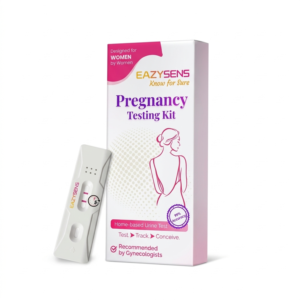
Our pregnancy test kit is made for women who want a simple, private, and convenient way to check pregnancy at home.
When used correctly and at the right time, home pregnancy tests are highly reliable and are widely used as the first step in pregnancy confirmation.
Easy Home Use
Clear Results
Private Testing
Early Detection
Helpful Guide
- The Science
The Architecture of Accuracy
Where clinical precision meets personal intuition.
Core Technology: Clinical Precision, At-Home Ease
- Gold-Conjugated Matrix: Utilizing advanced monoclonal antibodies within a lateral flow system for superior binding.
- The Private Laboratory: High-fidelity molecular technology distilled into a singular, elegant device for your space.
- Selective Capture: Precision-engineered to isolate specific biomarkers while filtering out “hormonal noise.”
- 99% Analytical Fidelity: Calibrated against rigorous global clinical standards to deliver undisputed accuracy.
- The 300-Second Genesis: Rapid chromatographic transit that processes complex biological data in exactly five minutes.
A Lifecycle of Clarity
- Pregnancy: Detecting the hCG “Biological Whisper” with
10mIU precision. - Ovulation: Identifying the “Luteinizing Pulse” to pinpoint peak
fertility window (typically within 24–36 hours).” - Menopause: Measuring “FSH Resonance” to validate your
transition into renewal. - UTI: A dual-parameter “Leukocyte Index” to identify irritation
before it escalates
Pregnancy:
The Genesis of Implantation
How It Actually Starts (Implantation Science)
Conception triggers a sophisticated hormonal dialogue. Once the embryo implants, the syncytiotrophoblast cells begin secreting hCG. This hormone acts as the primary "Biological Signal," instructing the body to sustain the corpus luteum and maintain the uterine environment. Eazysens detects this signal as it enters the renal system, capturing the earliest whispers of a new journey.
The 3-Parameter Detection Logic
Unlike standard tests, the pregnancy kit is optimized for three critical factors:
- Sensitivity Threshold: Detecting as low as 10–25 mIU/mL.
- Specificity Filter: Eliminating cross-reactivity with LH or FSH to prevent
“False Positives.” - Stability Matrix: A robust nitrocellulose membrane ensures the “Test
Line” remains stable and legible for accurate deciphering.
How the Lines Speak
The science of the visual confirmation
- Control (C): A built-in validation system that confirms the fluid has
flowed correctly and the reagents are active. - Test (T): The “Detection Zone” where gold-conjugated antibodies
aggregate if hCG is present, forming a visible pink bond.
- Frequently Asked
Your Questions, Answered.
How accurate is a home pregnancy test?
Most brands of at-home pregnancy tests are reliable, especially when used after the first missed period and according to instructions.
Can I take the test before my missed period?
Some products are marketed for early use, but accuracy is generally better after the first day of a missed period because hCG levels may be too low before that.
Can a negative result still mean pregnancy?
Yes. If you test too early, hCG may not yet be detectable in urine.
What is hCG?
hCG stands for human chorionic gonadotropin, a hormone the body produces during pregnancy after implantation.
What should I do after a positive result?
What if my result is invalid?
Repeat the test with a new kit and follow the instructions carefully.
Can symptoms alone confirm pregnancy?
No. Symptoms can suggest pregnancy, but only testing and medical confirmation can provide a reliable answer.
Still have questions?
Our health advisors are available to help you navigate your results and next steps — confidentially and without judgment.